Do Infrared Saunas Have Any Health Benefits? What Science Says
Infrared saunas are everywhere in the wellness world. But beyond the sweat and relaxing heat, do they actually do anything for your health?
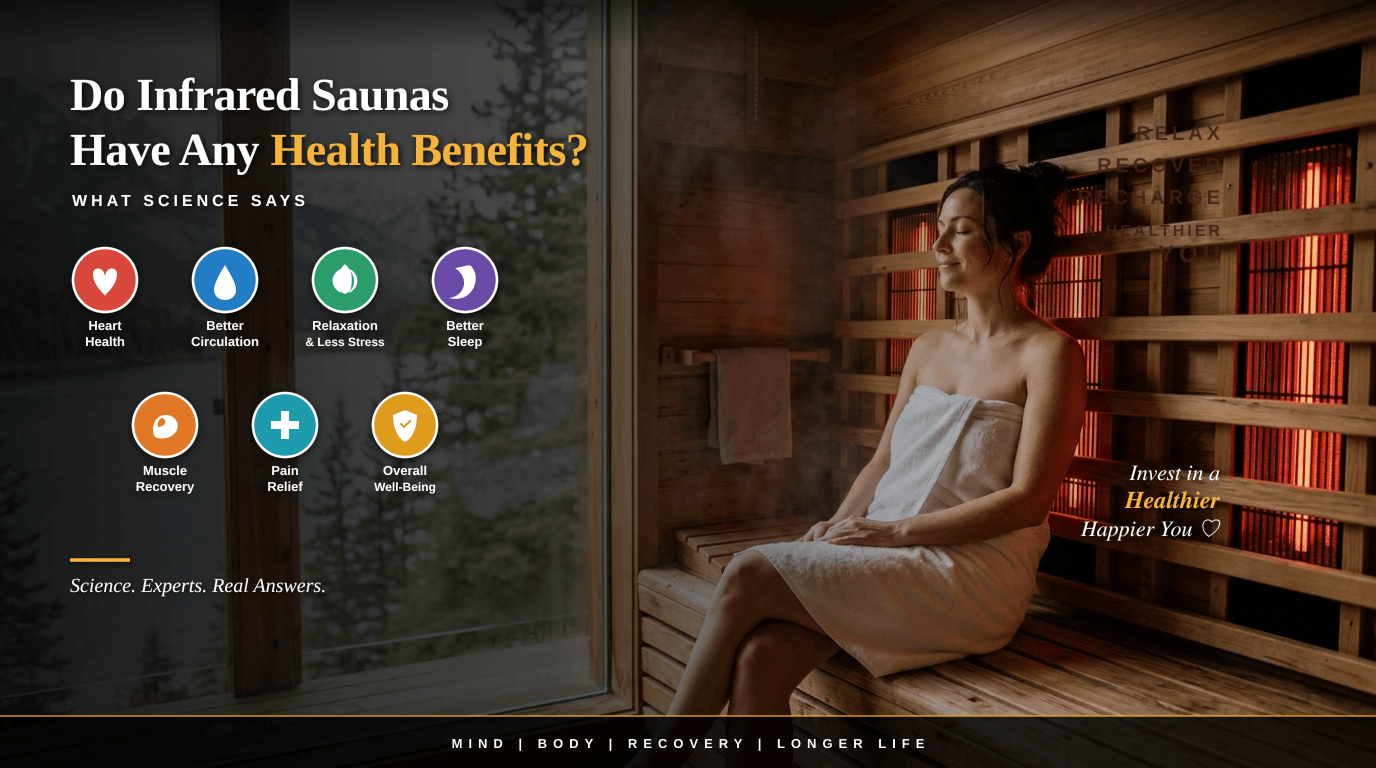
- Infrared saunas warm the body directly via light wavelengths at gentler temperatures (115°F–140°F) than traditional saunas (160°F–195°F).
- Heat exposure reliably induces increased heart rate, cutaneous blood flow, and sweating, simulating mild-to-moderate physical activity.
- Cardiovascular and circulation benefits are biologically plausible, with promising research from Finnish sauna studies and Waon infrared therapy.
- Clinical evidence does not support claims of miracle detoxification, significant fat loss, or curing chronic diseases; saunas serve as a complementary wellness tool.
Overview: The Evidence Behind Infrared Saunas
Health / Sauna & Wellness
Infrared saunas are everywhere in the wellness world. But beyond the sweat and relaxing heat, do they actually do anything for your health?
Search for infrared sauna health benefits and you will find almost every claim imaginable: better circulation, improved heart health, lower blood pressure, pain relief, detoxification, weight loss, better sleep, stress reduction and even longer life.
Some of these claims have a scientific basis. Some are promising but still being investigated. Others are much stronger than the available evidence allows.
So instead of asking what infrared sauna marketing says, let's ask a better question:
What do doctors, researchers and published scientific studies actually tell us about infrared saunas?
The short answer is that infrared saunas clearly produce real physiological heat responses, and research suggests potential benefits in several areas. But the evidence is not strong enough to call an infrared sauna a cure-all or a replacement for exercise, medical treatment or a healthy lifestyle.
Mayo Clinic explains that infrared saunas heat the body directly rather than primarily heating the surrounding air. They can produce responses similar to those caused by moderate exercise, such as increased heart rate and sweating, but at lower ambient temperatures than traditional saunas. Mayo also notes that studies have investigated conditions including high blood pressure, heart failure, arthritis and other chronic conditions while emphasizing that larger and more precise studies are still needed.
Read Mayo Clinic: Do infrared saunas have any health benefits?
What Is an Infrared Sauna?
A traditional sauna heats the surrounding air. Your body then absorbs that heat.
An infrared sauna works differently. Infrared radiation transfers heat more directly to the body, allowing the sauna to operate at a lower surrounding air temperature.
Cleveland Clinic describes infrared saunas as a lower-temperature form of sauna therapy and explains that heat exposure can increase sweating, blood flow and heart rate.
Cleveland Clinic: Infrared Saunas — What They Do and Health Benefits
The lower temperature can make infrared saunas more comfortable for people who find traditional sauna temperatures difficult to tolerate.
But lower temperature does not mean that infrared heat has no physiological effect.
Heat is still heat. Your body still has to regulate its temperature.
So, Do Infrared Saunas Actually Have Health Benefits?
Potentially, yes.
But the strength of the evidence depends on the particular health claim.
| Potential benefit | What the evidence suggests |
|---|---|
Circulation | Heat causes blood vessels near the skin to widen and increases blood flow. This is a well-established physiological response. |
Blood pressure | Heat can temporarily affect blood pressure and some studies suggest possible improvements, but results are mixed. |
Heart health | Sauna research is promising, particularly for traditional Finnish sauna bathing, but long-term infrared-specific evidence is more limited. |
Heart failure | Infrared sauna therapy has been studied in heart failure, with some short-term improvements in cardiac measures, but the evidence remains limited. |
Pain and muscle soreness | Heat may help some people with muscle soreness and certain pain conditions, but evidence varies by condition. |
Relaxation | Sauna sessions can be relaxing, although relaxation should not be confused with treatment for a diagnosed mental-health condition. |
Sleep | Relaxation may support a healthy bedtime routine, but strong infrared-specific evidence for treating insomnia is limited. |
Detoxification | Broad detox claims are much stronger than the clinical evidence. |
Weight loss | Sauna sessions cause temporary water loss through sweating, not meaningful body-fat loss. |
What Doctors Say About Infrared Saunas
Melissa Young, MD — Cleveland Clinic
Melissa Young, MD, a functional medicine specialist at Cleveland Clinic, has discussed infrared sauna therapy and its potential health effects.
Cleveland Clinic explains that infrared heat can cause blood vessels to widen, increase blood flow and raise heart rate. Dr. Young describes these physiological responses as resembling some aspects of exercise.
But this should not be misunderstood as proof that sitting in an infrared sauna is equivalent to exercising.
A randomized controlled crossover trial involving 10 healthy women compared infrared sauna exposure with moderate-intensity cycling. Researchers found substantial temperature changes with infrared sauna exposure but did not find significant differences between the interventions in several cardiovascular measures, including blood pressure, arterial stiffness and heart-rate variability.
The researchers concluded that the infrared sauna response was primarily a thermoregulatory response rather than an exercise-like cardiovascular activation.
Dr. Melissa Young — Cleveland Clinic
Cleveland Clinic's infrared sauna review
PubMed: Infrared sauna as exercise-mimetic?
Prashant Rao, MBBS — Harvard Medical School
Dr. Prashant Rao is a cardiologist and physician-scientist at Beth Israel Deaconess Medical Center and an instructor in medicine at Harvard Medical School.
Harvard Health's 2025 review explains that population studies involving thousands of people have found associations between regular sauna use and lower rates of cardiovascular disease.
But Dr. Rao emphasizes an important scientific limitation: researchers are still trying to determine whether sauna use itself causes those better outcomes.
People who regularly use saunas may also differ from people who do not use them in exercise habits, lifestyle, socioeconomic factors and other characteristics.
Harvard's review therefore makes an important practical point: sauna should complement exercise rather than replace it.
Dr. Prashant Rao — Harvard Health
Harvard Health: Can regular sauna sessions support a healthy heart?
Adolph Hutter, MD — Harvard Medical School
Dr. Adolph Hutter, professor of medicine at Harvard Medical School, has explained that high temperatures cause blood vessels to dilate and can lower blood pressure in some people.
That effect can be helpful for some people but also explains why sauna use can cause dizziness or lightheadedness, particularly in people whose blood pressure is already low.
Harvard Health recommends caution for people with certain heart conditions and emphasizes gradual cooling and hydration after sauna use.
Harvard Health: Hot baths and saunas — Dr. Hutter
Jari Laukkanen, MD, PhD — University of Eastern Finland
Jari Laukkanen is a cardiologist and professor at the University of Eastern Finland and one of the best-known researchers in the modern scientific literature on sauna bathing and cardiovascular health.
His research has contributed to a large body of evidence examining associations between sauna bathing, cardiovascular outcomes, blood pressure and other health measures.
However, there is an important distinction: much of the long-term evidence concerns traditional Finnish sauna bathing rather than infrared saunas specifically.
That means we should not automatically take a result from Finnish sauna research and claim that the exact same long-term benefit has been proven for every infrared sauna.
What Does Science Say About Heart Health?
Cardiovascular health is one of the most interesting areas of sauna research.
When the body is exposed to heat, blood vessels near the skin dilate. Heart rate rises and blood flow changes as the cardiovascular system works to move heat toward the body's surface.
These effects are real and measurable.
The harder question is whether repeated sauna exposure produces meaningful long-term improvements in cardiovascular health.
Traditional Finnish sauna research has produced striking observational findings. A major review led by Laukkanen and colleagues summarized evidence connecting frequent sauna bathing with cardiovascular outcomes and other health measures.
PubMed: Cardiovascular and Other Health Benefits of Sauna Bathing
But observational research cannot by itself prove that sauna use caused the benefit.
A person who regularly uses a sauna may also exercise more, have different dietary habits, experience different levels of stress or have other characteristics that influence health.
Harvard Health's 2025 review provides an important reality check. A randomized study involving people with stable coronary artery disease did not find meaningful differences in several vascular measures after eight weeks of Finnish sauna use. A broader 2025 review of randomized passive-heat studies found some evidence for modest reductions in blood pressure but inconsistent effects on many other cardiovascular measures.
Read Harvard Health's 2025 review
The scientific conclusion is therefore more nuanced than many wellness headlines suggest:
Sauna heat clearly affects cardiovascular physiology, and regular sauna use is associated with better cardiovascular outcomes in observational research. But the size and cause of any long-term cardiovascular benefit remain uncertain.
What About Infrared Saunas Specifically?
This is where the evidence becomes more limited.
The long-term sauna literature is much larger than the infrared-specific literature.
One randomized controlled crossover trial compared infrared sauna exposure with moderate-intensity cycling in 10 healthy women.
Infrared sauna exposure increased body temperature, but researchers did not find significant differences between the interventions in several cardiovascular measures.
The authors concluded that the infrared sauna response was driven primarily by thermoregulation rather than an exercise-mimicking cardiovascular effect.
PubMed: Infrared sauna as exercise-mimetic?
This is an important distinction.
An infrared sauna can raise your heart rate and body temperature. That does not mean that 30 minutes in an infrared sauna is equivalent to 30 minutes of cardiovascular exercise.
Can Infrared Saunas Help People With Heart Failure?
Infrared sauna therapy has been studied specifically in people with heart failure.
A systematic review and meta-analysis identified nine studies of sauna therapy in people with heart failure. Seven were included in the meta-analysis, and the studies meeting the relevant criteria involved infrared sauna therapy.
In the meta-analysis, a specific infrared sauna protocol — 60°C for 15 minutes followed by 30 minutes of rest in a warm environment, five times a week for two to four weeks — was associated with improvements in several short-term measures, including B-type natriuretic peptide, cardiothoracic ratio and left-ventricular ejection fraction.
However, there was no significant effect on systolic or diastolic blood pressure, and the researchers rated the strength of evidence from moderate to insufficient.
The authors concluded that more evidence is needed regarding long-term effects.
PubMed: Effects of sauna bath on heart failure — systematic review and meta-analysis
This should not be interpreted as saying that infrared saunas treat heart failure.
It means that researchers have observed potentially useful short-term changes under specific protocols that deserve further study.
Can Infrared Saunas Improve Circulation?
Yes. Heat exposure increases blood flow to the skin.
As the body heats up, blood vessels near the surface expand and the cardiovascular system moves more blood toward the skin to help release heat.
That is one of the clearest physiological effects of sauna exposure.
But there is a major difference between saying:
“Infrared heat increases blood flow.”
and saying:
“Infrared sauna treatment can clear blocked arteries.”
The second claim is not established by the evidence.
A scientifically responsible statement is that infrared heat produces measurable changes in blood flow and cardiovascular physiology while the long-term clinical significance of those changes remains under study.
Can Infrared Saunas Help With Muscle Recovery and Pain?
This is another area where the evidence is promising but not definitive.
Heat can increase circulation and may help some people feel less stiff or sore after physical activity.
Cleveland Clinic discusses potential benefits involving sore muscles and pain and cites research into infrared sauna therapy for chronic pain.
However, results vary by condition.
A study involving chronic pain cannot automatically be generalized to every sports injury, arthritis condition or back problem.
If you have severe pain, a new injury, significant swelling, weakness or neurological symptoms, sauna use should not replace appropriate medical evaluation.
What About Stress, Relaxation and Mood?
This may be one of the most realistic reasons to use an infrared sauna.
You sit down. Your muscles warm up. You are away from your phone for a while. You have a quiet environment and time to slow down.
That can be relaxing.
Cleveland Clinic discusses relaxation as one potential benefit of sauna use.
But there is an important difference between saying:
“A sauna session can be relaxing.”
and saying:
“Infrared sauna therapy treats depression or anxiety.”
The first is a reasonable wellness statement. The second requires much stronger clinical evidence.
People with persistent depression, severe anxiety or another mental-health condition should not use sauna as a substitute for professional care.
Can Infrared Saunas Help You Sleep?
Possibly, particularly as part of a relaxing routine.
Heat exposure changes body temperature, and the relaxation that follows a sauna session may help some people transition toward sleep.
But strong evidence that infrared saunas specifically treat insomnia is limited.
A better statement is that an infrared sauna may support a relaxing bedtime routine, rather than claiming that it cures sleep disorders.
Do Infrared Saunas Detox the Body?
This is where wellness marketing often gets ahead of science.
Yes, you sweat in a sauna.
Sweat contains water, electrolytes and small amounts of various substances.
But the body's main systems for processing and eliminating waste include the liver and kidneys.
There is not strong clinical evidence that infrared sauna sessions “detoxify” the body in the dramatic way that some online advertisements suggest.
Cleveland Clinic also describes sauna detoxification claims as an area where research remains limited.
Cleveland Clinic on infrared sauna detox claims
So if someone says an infrared sauna can completely remove toxins after unhealthy eating or eliminate heavy metals through sweating, the claim deserves skepticism.
Can Infrared Saunas Help You Lose Weight?
A sauna session can make the scale move.
But the reason is usually simple: water loss through sweating.
Losing water is not the same thing as losing body fat.
Once you replace those fluids, much of the temporary weight difference disappears.
An infrared sauna can be part of a healthy lifestyle, but it should not be marketed as a substitute for nutrition, resistance training or regular cardiovascular activity.
Infrared vs. Traditional Sauna: What Does the Evidence Actually Show?
Traditional Finnish sauna research is considerably larger than the infrared-specific research base.
This matters.
If a study finds that frequent traditional Finnish sauna use is associated with a particular long-term health outcome, we should not automatically write:
“Infrared saunas have been proven to produce the same benefit.”
Traditional Finnish saunas generally involve higher air temperatures and different patterns of use.
Infrared saunas typically operate at lower ambient temperatures and transfer heat differently.
Mayo Clinic explains the basic difference between these two forms of sauna.
Mayo Clinic: Infrared vs. traditional sauna
The scientifically honest answer is therefore not that one is universally “better.”
They are different forms of heat exposure, and the evidence base is different.
What Famous Sauna Researchers Have Found
Jari Laukkanen and the Finnish Sauna Research Tradition
Professor Jari Laukkanen's work is frequently cited in discussions of sauna and cardiovascular health because his research has examined large populations and cardiovascular outcomes.
His work helped establish sauna bathing as a serious subject of cardiovascular research rather than merely a wellness trend.
At the same time, his research illustrates why careful wording matters: much of the strongest long-term evidence concerns Finnish sauna bathing, not modern infrared cabins.
University of Eastern Finland: Jari Laukkanen
What Harvard Health Says
Harvard Health's recent review provides an important counterbalance to enthusiastic sauna claims.
The review acknowledges the striking observational evidence while also explaining that randomized trials have produced more mixed findings.
That distinction is important in health science: promising evidence is not the same thing as proof.
Harvard Health: Can regular sauna sessions support a healthy heart?
What Infrared Sauna Research Does Not Prove
A strong health article should explain not only what research suggests, but also what it does not prove.
These limitations do not mean infrared saunas are useless.
They mean we should separate what is established, what is promising and what remains uncertain.
Are Infrared Saunas Safe?
For many healthy adults, sauna use can be a reasonable wellness activity when used appropriately.
But heat exposure is not risk-free.
Possible problems include dehydration, dizziness, overheating and temporary changes in blood pressure.
Cleveland Clinic recommends starting gradually and leaving the sauna if you become dizzy or nauseated.
Harvard Health similarly recommends caution for people with low blood pressure and certain heart conditions.
People who are pregnant, heat-intolerant, acutely ill or managing certain cardiovascular or other medical conditions should ask a qualified healthcare professional before using a sauna.
How to Use an Infrared Sauna More Safely
The Most Honest Answer to “Do Infrared Saunas Have Any Health Benefits?”
Yes — there are legitimate reasons to think infrared sauna use can provide health and wellness benefits.
Infrared heat clearly produces real changes in body temperature, sweating, blood flow and heart rate.
Clinical research has also produced promising findings in areas including cardiovascular function, pain and certain heart-failure measures.
But the biggest claims need more evidence.
Mayo Clinic's conclusion is appropriately cautious: studies have found some evidence of potential benefits, but larger and more precise studies are needed to establish many of the claimed health effects.
Harvard Health's more recent analysis reinforces another important lesson: associations between regular sauna use and better health do not automatically prove that sauna use itself caused the long-term outcomes.
The most scientifically responsible way to think about an infrared sauna is as a form of passive heat exposure that may complement a healthy lifestyle — not as a miracle machine.
What an Infrared Sauna Can Complement
If you enjoy infrared sauna sessions, the most sensible approach is to use them alongside the foundations of good health:
Think of the sauna as an addition, not the foundation.
Frequently Asked Questions
Do infrared saunas have any health benefits?
Infrared saunas produce real physiological heat responses, including increased sweating, heart rate and blood flow. Research also suggests potential benefits in areas such as cardiovascular function, pain and relaxation. However, larger and more precise studies are needed to establish many long-term health claims.
Are infrared saunas better than traditional saunas?
Not necessarily. They work differently. Infrared saunas generally operate at lower ambient temperatures and heat the body more directly. Much of the long-term sauna research involves traditional Finnish sauna bathing, so it should not automatically be applied to infrared saunas.
Can infrared saunas lower blood pressure?
Heat can dilate blood vessels and temporarily affect blood pressure. Some studies suggest possible improvements, but the evidence is mixed. An infrared sauna should never replace prescribed blood-pressure treatment.
Can infrared saunas help with muscle recovery?
Heat and increased blood flow may help some people feel less stiff or sore. Cleveland Clinic discusses potential muscle recovery and pain benefits, but evidence varies by condition.
Do infrared saunas burn fat?
Sauna sessions can cause temporary weight loss through sweating and fluid loss, but that is not the same as losing body fat. Sauna use should not be considered a weight-loss treatment.
Do infrared saunas detox the body?
There is not strong evidence supporting broad “detox” claims. Sweating is primarily a thermoregulatory process, while the liver and kidneys perform major waste-processing and elimination functions.
Can infrared saunas replace exercise?
No. Infrared sauna exposure can raise heart rate and body temperature, but research does not establish it as a replacement for regular physical activity.
How long should you stay in an infrared sauna?
There is no single duration that is appropriate for everyone. Start with shorter sessions and follow the manufacturer's instructions. Stop if you feel dizzy, nauseated, weak or excessively uncomfortable. People with medical conditions should ask their healthcare professional for individualized advice.
Scientific Sources & Further Reading
Final Takeaway
Infrared saunas are not magic, and they are not merely hype either.
The science shows that infrared heat can produce real changes in body temperature, blood flow, heart rate and sweating.
Clinical research has also produced promising findings in areas including cardiovascular function, pain and certain heart-failure measures.
At the same time, many of the biggest claims surrounding infrared saunas remain ahead of the evidence.
If you enjoy using one, the most evidence-conscious way to think about it is simple:
Use an infrared sauna as a wellness tool that may complement a healthy lifestyle — not as a replacement for exercise, medical care or proven treatments.
Good health rarely comes from one device. It comes from a collection of habits that work together over time.
<small> Medical disclaimer: This article is for educational purposes only and is not medical advice, diagnosis or treatment. Research findings do not guarantee the same results for every individual. If you have a medical condition, take medications that affect blood pressure or sweating, are pregnant, or have concerns about whether sauna use is appropriate for you, speak with a qualified healthcare professional before using an infrared sauna. </small>
Frequently Asked Questions

Elena Vance
Wellness & Recovery WriterWellness & Heat Therapy Contributor
Elena Vance writes on thermotherapy, sauna traditions, cold plunge protocols, and post-exercise muscular recovery. Her editorial approach combines verified physiological principles with practical equipment safety and residential installation guidance.
Enjoying this guide?
Get our latest practical reviews, home fitness recommendations, and appliance guides delivered straight to your inbox.
Recommended Reading

Traditional vs. Infrared Sauna: Thermal Physics, Cabin Dynamics & Recovery Protocols
Both traditional Finnish steam saunas and modern infrared cabins offer deeply therapeutic heat exposure, but their underlying heating mechanisms, electrical footprints, and sensations differ fundamentally. Here is how to choose.

Sauna Safety & Heat Therapy Protocol: Exposure Times, Hydration & Beginner Guidelines
Heat bathing offers profound relaxation, but pushing past tolerance leads to dehydration and orthostatic dizziness. Here is how to structure safe, restorative sauna routines.

Home Sauna Buying Guide: Indoor Cabins, Outdoor Barrels & Modular Kits
Installing a sauna at home requires planning electrical amperage, subfloor weight tolerance, and cedar vs hemlock timber. Here is how to evaluate kits and avoid expensive mistakes.